Workation France: To Hamburg and the North Sea, Part 1

When your German friends invite you to take a walk on the beach, ask how many tens of kilometers they plan to march before you answer.

We took a break from our workation* in Chamonix to visit our dear friends Uwe and Frauke in Hamburg last weekend.

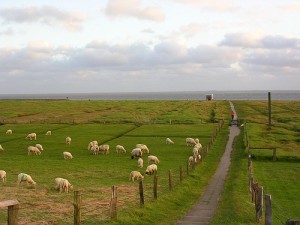
Lambs (and sheep!) on Hamburger Hallig

Lambs (and sheep!) on Hamburger Hallig

Uwe decided that after spending so much time in the Alps, we were due for a trip to the beach, and I agreed. He planned a weekend at the North Sea that included a stroll on the beach, a hike across tidal flats to an island, and dining on a local specialty that’s only available at this time of the year.

Friday evening we left Hamburg’s luxe riverside homes behind for the area near Sylt, which Uwe said was one of the most beautiful (and popular) islands in Germany. But before we headed to the island, we had a mandatory stop at Hamburger Hallig–but not for hamburgers. For lamb.

Uwe had been talking about the “nice, juicy little lambs” since I asked if we could visit. They’re special, he said, because they feast on grasses watered by the high tide and therefore take on the sea’s salty flavor.

As we approached the restaurant–and unassuming farmhouse perched hopefully atop the highest part of a hallig, a German word for the miniscule islands just off the coast–Frauke and Uwe had a quick debate in German and told us we were going to pay to drive right up to the farmhouse, even though they usually walk or rent bikes. Was Uwe too anxious for his juicy lamb to hike or bike? The wind was howling off the sea, so I was happy not to pedal a bike into it and said so. “Oh, the wind is not a problem,” Frauke said. “But if it rains, we don’t want to have to walk all the way back here in it.”

This should have been my first clue about the hearty constitution of my German friends and the activities and weather they think are “not a problem.”

Jeremy in the wind on the North Sea

Jeremy in the wind on the North Sea

So as not to miss the juiciest part of the lamb, the leg, we rushed in just as the buffet began, quickly ordered beers and apfelschorles, and snuck around the hostess who told us to wait, a large group would get to go before us. The lamb was juicy, and it was available in every cut and cooked in every conceivable way. I woffed down most of two plates before calling it quits–Uwe ate three and cleaned his plate each time.

Uwe and Frauke swore us to secrecy about their juicy little lambs and made me promise not to publish the name of the restaurant. It is little known, out of the way, and only hosts the lamb buffet on Friday nights for a few weeks in June and July. If you absolutely must know, drop me a line.

The next day, we headed to Sylt for a “nice walk along the beach.” The wind was still howling, but the sun was out.

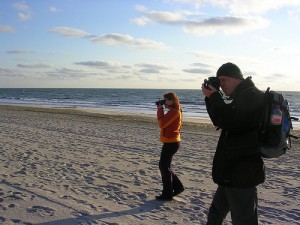
Uwe and Frauke shooting pictures of the Red Cliffs on Sylt

Uwe and Frauke shooting pictures of the Red Cliffs on Sylt

Still, when we arrived at Sylt’s main city, Westerland, to take a bus to the northern elbow of the strip of island, Jeremy and I ducked into a shop with a big The North Face logo to buy more clothes. I regretted leaving my fleece pullover and gloves in Chamonix; Jeremy regretted not bringing a hat. We both wondered at the drones of German tourists in capri pants shrugging off the cold gale at their favorite beach resort.

Properly equipped with warmer clothes and a lunch of fish sandwhiches (local specialities include tiny shrimp and a type of pickled herring–both delicious!), we headed onto the beach where Jeremy and I shoved our gloveless hands into our pockets against the wind and Uwe and Frauke promptly removed their shoes.

“It’s not cold–it’s quite warm in the sand, Jenn!”

“It’s good for your feet to walk in the sand!”

“Yes, the sand massages your feet!”

Now, let’s just pause here. I’m not as tough as most of my friends, but that speaks to the company I keep more than my own wimpiness. I’m not afraid of cold–I ski and ice climb all winter, and before those sports were available to me, I always rode my bikes through the winter. But I survive my cold-weather activities because I dress appropriately and don’t do crazy things like take my shoes and socks off.

So what did I do? I took my shoes and socks off. And that’s when the march began.

We marched at least 14 kilometers (8.7 miles) down the beach, in the sand, back to Westerland.

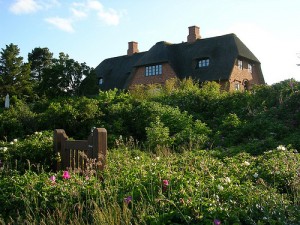
The homes in Kampen have roofes made of reed, which is traditional in northern Germany.

The homes in Kampen have roofs made of reed, which is traditional in northern Germany.

That doesn’t include the side trip to see some of Germany’s most expensive homes, in Kampen; we ended up on the mainland side of Sylt before heading back to the sea side, thus crossing the island’s width twice. We ate our yummy fish sandwiches, stopped for coffee and creamy cakes once. Walking so far on the rough sea was an incredible experience, but by 8 or 9 p.m., dragging my exfoliated feet and licking salt off my lips, I declared that I would walk no further unless someone put dinner in my belly.

Even after dinner (more of the tasty tiny shrimp with a huge organic salad) we had an hour-long walk/run to make the midnight train out of Westerland. When we arrived back at our flat after 1 a.m., I wasn’t sure how I’d manage to get up at 7:30 to make it to our walking tour to the hallig of Oland. But if I wanted to walk to an island–and I did–I had no choice.

*This summer, I’m conducting a work/play experiment in the Alps. I’ve moved my home office from Colorado to Chamonix, a lovely but sometimes insanely touristy town at the foot of Mont Blanc. This post is the fourth in a series about temporarily living and working in a premiere trekking and climbing destination–and another country.

Workation France: What to Bring

Five things you should bring from home, four of which I’ve spent way too much money on since we’ve arrived in France but are essential for a workation*:

Sunscreen: You can’t skate out of a pharmacy or even a grocery store with sunscreen for under 10 euro, about $13.85 at the current exchange rate. Even tiny travel-size bottles are pricey, and in the haute montagne, you need it. (Actually, I picked up my toastiest sunburn at the crag at Les Gaillands, in the valley! It’s a south-facing cliff.)

Envelopes: For a vacation, you don’t need envelopes, but for a workation, you probably will need to send something back home via snailmail. It would have been easy to bring along a handful of envelopes from home. Instead, I bought a pack of 50 here for what I could have bought 500 for at Office Depot.

Saline Solution: We ran out of saline solution today, and I discovered why the big bottles of the stuff are behind the counter at the pharmacy here: You could get a nice bottle of wine for less. It’s possible that I was gouged for buying on one of the main streets in touristy Chamonix, but fact is, it’s so pricey I’d get laser surgery to save money if I lived here.

Trail Mix: I like to eat trail mix when I hike and climb; it’s part of my real-food trail energy regime. If you shop at Whole Foods, it’s easy to become a trail-mix junkie and sample many varieties in the bulk section for a fair sum. In France, though, you’ll either pay a lot for a tiny bit of pitiful mix, or you’ll pay a lot to put the raw materials together yourself. A big bag of my favorite mix would be more useful at this point than an extra shirt or socks.

Energy Bars: These don’t exist here. If you can’t hike or climb without your favorite Clif Bar or Lara Bar or whatever, you’d be wise to bring a box or three, depending on your voracity.

And now one thing you don’t need to bring to France: your health insurance card. Well, if you end up in the hospital you might need it…anyway, if you go to a doctor here, like I did last week, you’ll have to pay cash up front and submit to insurance later. In my case, a visit to the doctor put me out 60 euro, which is less than it costs me to see a doctor back home since I have the crappy insurance that the self-employed are forced to buy in the U.S. Last year, my little brother went to a doctor in Zermatt, which was 35 Swiss francs (pretty close to the same amount in dollars). Perhaps here, the health-care industry is making bank on saline solution and sunscreen rather than sick people.

*This summer, I’m conducting a work/play experiment in the Alps. I’ve moved my home office from Colorado to Chamonix, a lovely but sometimes insanely touristy town at the foot of Mont Blanc. This post is the third in a series about temporarily living and working in a premiere trekking and climbing destination–and another country.

The Alps, the laissez-faire way

The Brévent, from Chamonix

The Brévent, from Chamonix

If you live away from the mountains, the only time you hear about a climbing accident is if something big goes down on Mt. Everest, or if the Today Show picks up an amazing tale of survival from a fourteener hike gone wrong. But when you live in the mountains, climbing and skiing accidents appear in your local news on a regular basis.

We can’t easily read the local news here, but we heard helicopters all day on Friday. We woke to the rat-tat-tat in the morning, saw them when we hiked on the northwest side of the valley in the afternoon, and by evening, when they were still going, we wondered whether they were having an epic training day or if something bad went down.

There was an accident. Jeremy spotted a blurb about it Saturday on ESPN:

“Karine Ruby, a former Olympic snowboarding champion who had been training to become a mountain guide, died Friday in a climbing accident on Mont Blanc. She was 31. Ruby was roped to other climbers when she and some members of the group fell into a deep crack in the glacier on the way down the mountain…”

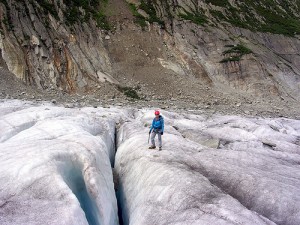
But we didn’t have time to ponder it, because–timely–that evening we were sorting gear and loading our packs to spend the next day out with guide Michael Silitch learning how to travel safely on the glaciers above Chamonix.

Last year we climbed the Cosmiques Arete with Michael (the photos he snapped along the way are here–by the way, how do guides take such great photos and give clients safe belays at the same time?!?). Neither of us have experience with glacier travel, so this year we wanted to learn safety basics so we can start doing easy alpine climbs on our own.

Sunday morning broke sunny atop the Aiguille du Midi cable car station, and from the observation decks we could see that the Vallée Blanche was crawling with people.

The view from the Aiguille du Midi

The view from the Aiguille du Midi

Across the valley, another swarm was either switchbacking up to or skiing down from a bowl on Mont Blanc du Tacul–which Michael pointed out was an avalanche terrain trap, and then directed our attention to the rows of tipping seracs most of the way up the mountain above. As if on cue, we heard a roar from another direction and spotted an avalanche below us on the Midi, and as it thundered on, Michael explained that seracs can fall at any time, day or night.

Great. Or as they like to say here, super.

We spiked up and tied in for the daunting trip down a ridge from the station to the Vallée Blanche. The soft snow started balling up under my crampons, and Michael pointed out that they’re really only good for ice climbing, not alpine climbing. And by the way, our ice axes aren’t quite right either. Gah. I need to make friends with someone at Grivel or Petzl.

Michael whipped out a snow probe and staked out a safe area on a flat spot between the ridge and the bergschrund (the Vallée Blanche is a glacier). Below, the climbers and skiers became the subjects of our class. A few people were doing everything right (”See that team of two? They’re far apart, and there’s no slack in the rope.”) but it seemed like a lot of people were doing everything wrong (”These people have way too much slack in the rope; those people are standing around too close together; that guy is alone without skis.”).

“Some of the French are kind of laissez-faire about this stuff,” Michael said. Eh, oui: It seemed like there was a lot of scary stuff going on.

Michael pointed out the area where Friday’s accident happened and said there wasn’t much information about it–everyone in the party died–so it was tough to analyze what went wrong. There are huge crevasses up there, though, so he wondered if they had gathered too close together on a snow bridge over a crevasse, and when it broke, it took all of them.

As people passed around us on their way to and from the cable car station, we offered bonjours, and Michael sometimes offered a more brotherly salut to other guides. Karine was a friend of his, he said, and a beloved member of the community. She was trying to become the second woman in the exclusive (and quite traditional) Compagnie des Guides de Chamonix.

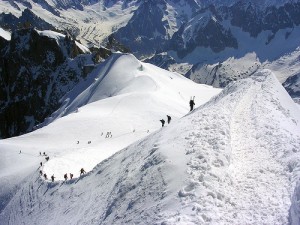
Ridge to the Vallée Blanche from the Aiguille du Midi

Ridge to the Vallée Blanche from the Aiguille du Midi

Not to be presumptive, but I suspect it’s best not to dwell on death, even the death of a friend, when your profession is to guide people through deadly terrain on a regular basis, and he didn’t–he moved on to the text topic. But it’s staring you in the face in a place like this. In fact, as Michael was talking us through how to set up rope teams, a party that was heading back up to the station took a long break behind us because one of its members seemed to be having mountain sickness of some sort. He was on his back, rolling around and moaning. One of his buddies put his crampons on for him.

As we transitioned the rope to the appropriate length to walk down onto the glacier, Michael said the man probably had cerebral edema.

“Really?” we said.

“Yeah, people come up from Paris and go right to 12,000 feet,” he said. Ah. Just like back home in Colorado, where people fly in from Chicago to ski at 11,000 feet and end up with Acute Mountain Sickness.

Clouds had been building from the Italian side of the range all day, but by mid afternoon, gray clouds rose from the Chamonix side, too.

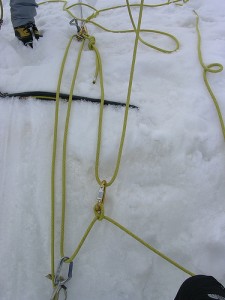
How to haul someone out of a crevasse: Learn to build pulleys

How to haul someone out of a crevasse: Learn to build pulleys

A few snowflakes blew in as I puzzled over the pulley system Michael had built to rescue his pack–our faux fallen climber. I’m extra paranoid about lightning after an experience we had last summer in the Indian Peaks, and we all thought it would be good to avoid yet another mountain hazard.

Back at the Aiguille du Midi station, we packed up or covered our sharp objects for the journey back down to Chamonix. The tourists are aggressive when queueing up for the cable cars (even to people carrying ice axes), and at 125 lbs., I’m often jostled about by the crowd once we’re squeezed into the car. On one leg of this journey, I was backed up to a large man wearing a tiny pack, which you’re supposed to remove before you get in the cable car. He removed his pack while I was pressed against it. The French couple next to me giggled in shock and gestured for me to jab him with my elbows. I wished my glacier-inappropriate ice axe was accessible. The tourists, it turns out, are the final hazard you have to deal with when climbing in the Alps.

This summer, I’m conducting a work/play experiment in the Alps. I’ve moved my home office from Colorado to Chamonix, a lovely but sometimes insanely touristy town at the foot of Mont Blanc. This post is the second in a series about temporarily living and working in a premiere trekking and climbing destination–and another country.

Workation France: Squeezing In

This summer, I’m conducting a work/play experiment in the Alps. I’ve moved my home office from Colorado to Chamonix, a lovely but sometimes insanely touristy town at the foot of Mont Blanc. This post is the first in a series about temporarily living and working in a premiere trekking and climbing destination–and another country.

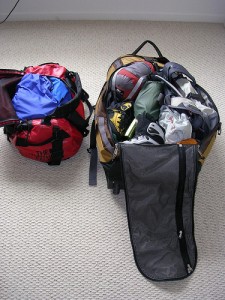
Settling in to our apartment in Chamonix has brought on flashbacks of moving into our college dorm rooms. We don’t have enough closet space. Our “desk” is a multi-purpose surface: dinner table, dump for change and keys, home to two laptops and a French press every morning. The climbing gear is stashed under the bed. The backpacks are shoved into a corner of the living room. And there’s nowhere to put the luggage once we finish emptying it, because our ski locker in the basement is literally only wide enough for skis.

At least this time I know I’ll like my roommate.

But one glance out the window of our top-floor apartment at the peaks just a walk away makes the squeeze inside irrelevant. And sure, we can’t quite manage to unpack in a week’s time, but we’ve already done the three things we came here to do: climb, hike and work.

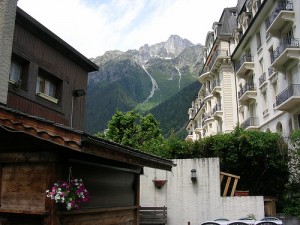
Downtown, looking toward Mont Blanc, on a quiet Monday

Downtown Chamonix, looking toward Mont Blanc, on a quiet Monday

The work part has been the toughest, so far. It’s better now that the jet lag has worn off, but working in the evenings so we can be available to people back home (and hike and climb during the day) requires a mental switch. My brain is accustomed to working in the mornings and being lazy at night. No more.

Climbing was the easiest of our three objectives, for this week. The local crag at Les Gaillands is on the edge of a little lakeside park, and it’s just a 15 or 20 minute walk down the road from our apartment. Once there, turn away from the rock and you have an unobstructed jaw-dropper of Mont Blanc, the Chamonix Aiguilles, and the Bossons and Taconnaz glaciers spilling down from the heights.

The crag is covered in well-bolted moderate routes, and even on a gorgeous Saturday when it was swarming with people, we had no trouble getting on climbs. Before we left Colorado, a friend–who loaned us a stack of Chamonix guide books, thanks Michelle!–said to make sure we learn to know when someone is about to butt in on your route in other languages. That might be true on some of the popular alpine routes we’re scoping out for the near future, but at Les Gaillands, people were friendly in many languages.

View up the Mer de Glace from Montenvers

View up the Mer de Glace from Montenvers

Between climbing days, we hiked from town. Our first hike was somewhat unnatural by Chamonix standards, because we hiked up to Montenvers, and most folks arrive at this destination overlooking the Mer de Glace by the cog train from Chamonix. If you happen to hike the old mule trail between Montenvers and Cham, it’s probably only downhill, after ascending via the train. Accessibility to the high trails by train or cable car is one of the benefits of trekking around here–rather than spending hours hiking up the steep trails out of town to treeline, you arrive there in 10 or 20 minutes (and 20 or so Euros poorer).

The biggest advantage of hiking from town? Getting fit for longer days high up in the Alps. More of that to come.

Long Haul

Traveling for a few weeks is pretty easy. Working away from home for a few months requires a little more planning (and apparently a little more anxiety, eesh!).

On Saturday, we’ll move our home office to Chamonix Mont-Blanc, France, for the next few months. The eight-hour shift east will be more than a change of time zone that requires us to work in the evenings rather than the mornings. I suspect it will be a shift in our perception of freelancing that will make the word “telecommute” take on a more global meaning.

But enough of the high-falutin’ ideological stuff. If you don’t take care of some mundane details before you leave home, you won’t be working from another country–you’ll be wasting time making expensive phone calls or shopping for an extra power converter.

Mail: The post office will only hold your mail for a month. If you don’t have family or friends around who can pick up and sort your mail, Earth Class Mail might be your best bet for collecting your mail and sending you anything you need. Otherwise, leave behind pre-stamped, pre-addressed flat-rate envelopes for your mail jockey so it’s easy for him/her to send you anything.

Phones: This isn’t news, but I have to reiterate that Skype is the thing that really makes it possible to work from anywhere. We’re going to buy a U.S. number through Skype so anyone can call us–in fact, they won’t even know they’re calling Skype, or calling us in France. Unless I get that crazy echo through my headset.

Your car: Your car can sit at the airport for two weeks. But it can’t sit there, or anywhere, for months on end. Someone has to take it for a spin once in a while, so hand over your keys to a friend who doesn’t text while driving.

Power adapters: We usually travel with one adapter for a computer, one for everything else. Since we’ll both be working, though, we’ve picked up an extra so we don’t have to fight over a single adapter.

Prescriptions: Take care of these at least a week before you leave. It might take your pharmacist a few days to extend refills from your doctor or wrestle with your insurance company for a vacation supply of your medication.

Gardening: We’ve done everything we can think of to make our home lives as low maintenance as possible. We don’t have kids, pets or even plants. We don’t have grass or a yard. We have a 30-by-15 foot rectangle of a few bushes and a lot of rock. And we still have to weed the rocks every few weeks. If you don’t figure out a plan for your yard, or in our case, “yard,” your neighbors or HOA or both will hate you when you return.

Smugness: Obviously it’s best not to be smug at all, but if you’re a little smug, keep it to yourself before you leave. Your friends at home won’t appreciate statements like, “Sucker! You’ll be working in your dismal cube next week while I’ll be working on the beach/in a European cafe/from a sailboat.” Plus, you don’t want that smug karma to bite you in the ass–you could find yourself working from an eight-Euro-an hour cyber cafe with medievally-slow Internet on a keyboard you can’t comprehend.

Haiku writers

Copywriter Ken Grindall found me here and discovered that like him, I am a big fan of haiku. Yay interwebz connections, right? But this new connection served as a reminder that I haven’t haikued in some time. So here’s one to all of you writers like us who occasionally take a break from your usual writing style to bust out new words, strange punctuation, or a total lack of grammatical consideration via haiku:

paid by the word or

for the word, just want to use

‘kerfuffle’ somewhere

Stuck, Climbing Cheese Graters

The sun was low on the horizon, blackening the Joshua Trees into silhouette, and long after our brief climb was over, we still hadn’t found our way off of this bloody rock.

But I didn’t feel that knot of danger in my stomach that comes with the realization that you might have to spend the night out in the wilderness. No–we were in sight of our campground, for chrissakes. Below us, other climbers were starting their campfires and popping open cold beers. We felt stupid for getting stuck on top of this rock and just wanted to get down and start our own campfire. And we wanted to do it without having to yell to a camper, “Where’s the downclimb?!?”

We’d been warned. If you utter the word “Josh” to a climber, you’ll hear tales of challenging downclimbs and cheese-grater rock. Joshua Tree’s granite is notoriously rough and ragged, and taping your hands is de rigueur. So is learning to downclimb 5.6 to get off of the big granite boulders.

We were not good at either.

Despite the warnings, on our first Josh climb–a few days before getting stuck on the rock above our campground–I wasn’t prepared to see blood on my hands before I’d even left the ground. I was huffing and sweating and stuck on the ground. Ignoring the fresh red blobs around my cuticles, I ground my fingers back into the monzogranite crack, pressed hard against the cheese-grater rock, and finally hauled myself off the ground with an unsatisfying grunt on the fourth try. We walked away from Day One slightly scarred and unsure whether we were having fun climbing here.

Now we were stuck atop a rock, stuck atop an “easy” climb, but not at all comfortable with the idea of downclimbing the exposed slabs that seemed to be the only way down. One slip would be a long fall against the cheese grater.

Call me crazy, or unadventurous, but I like to know how to get down off of a climb before we get to the top. So we’d checked our guidebook and even asked a soloist for descent beta. He’d soloed our route just before we climbed it.

“Which downclimb did you use?”

“The one on the northeast side. It’s pretty good, but it requires some skill.”

Soloists are notoriously understated.

Since we topped out on the southwest side of the rock, we searched for the downclimb there first–to no avail. We crossed to the northeast side–where the soloist descended–and again faced dubious downclimbs. But we had a glimpse of hope when we found an arch on the very top of the rock we could sling to rappel part of the way down. At the very least, we could get a better look, we thought.

Jeremy looped our rope around the arch and rappeled first. I watched our rope smash into the giant granite crystals as he weighted it. When he finished, the rope didn’t budge–it stuck to the rock like we’d superglued it there.

“I’m worried that we won’t be able to pull the rope after I rap down!” I yelled.

“Really? Crap.” We were equally concerned and pissed off but didn’t have much choice. The light was fading fast; so was my stomach for this situation. I rappeled, stopped on a broad slab next to him, and tried to pull one end of the rope.

It was stuck. We whipped it around wildly to no avail. The worst part? We still didn’t see a way down from here, either.

“Okay, you go retrieve the rope, and I’ll look for the downclimb,” I said.

Cursing, Jeremy ascended the rope while I slinked down to the edge of the slab. It only got steeper. But a wide crack to the east looked like a possible chimney we could downclimb.

Jeremy, usually mild mannered, came back cursing even more. “I can’t believe we had to leave gear behind on this climb. And we still don’t know if we can get down over here.” But I was hopeful about the chimney. He came down and wedged himself in it to belay me through the possible downclimb I’d found.

The guidebook said the downclimb involved ducking under a chockstone. I didn’t duck under anything, so I doubt this was the “official” downclimb, but it worked–it was exposed, but with big hand holds. We were tired and frustrated (and ready to hurl gear at the guidebook author, had he been there), so in an attempt to be Capt. Saftey, I placed gear as I descended to a ledge (I’ve never placed gear for a downclimb, but oh well) so if Jeremy fell descending, he wouldn’t fall as far.

We were down.

Wait, we were not down. We weren’t more than 15 feet off the ground, but we were stuck in a maze of rocks and cacti. Are you effing kidding me?!?

Okay, after a brief wander through the rock labyrinth, we really were down. We walked back around to our packs in dusk. Above our packs, we spotted a pair of climbers–one using a headlamp since it was nearly dark now–near where we had turned away from the “downclimb” off the southwest corner of the rock.

“Hey, are you guys okay?” I called up.

“Oh hey! No, the last time I did this, there were rap bolts, but they’ve been chopped. Do you know where the downclimb is?”

Great things about blizzards

Yep, we’re having a blizzard here in Colorado today. But there are a few really great things about my situation:
- I’m a freelancer, so I’m already hunkered down at work. I didn’t have to debate whether to go in to the office this morning (when it was reasonable to consider leaving the house).
- We’re gear junkies, so we have plenty of gear for dealing with snow–warm clothes, crampons, snowshoes, goggles. I’m considering skiing over to my local pizza place for dinner, if they’re open. Considering the wind, I should probably wear my helmet.
- Yes, cornices are forming on my roof, and the wind is piling snow onto my front walk at an alarming rate. But we have a regular old snow shovel, plus the tiny ones you can carry on a backpack.
- The internet is alive and well, and so is the heat. If things go south with our modern comforts, we have a camp stove.
- Temps are supposed to be back in the 50s this weekend, so I’ll be able to leave the house and drive to the mountains to ski (beyond my pizza place).

- A snow day is a perfect day to stay home and write. If you’re not busy skiing for pizza.

Betty Ice Ball

I have two posts on the Betty Ice Ball floating around the interweb right now:

1. Your standard event rehashing with a fun anecdote thrown in from yours truly at Climbing magazine, and

2. Five things you get more of when you climb with Chicks, posted at All Climbing. Thanks, Tom, for letting me be your guest blogger!

People who push

Last year, my husband took up skiing again after a long absence, and after taking a class with the Colorado Mountain Club, he went out with our friends for a seemingly innocent day at a resort.

“I’m pretty sure Mark and Judy were trying to kill me,” he reported upon his return home, grinning broadly in the way outdoorsy types do upon surviving a challenging day.

This is why we like Mark and Judy.

Last week, we were all in Ouray to ice climb and took a day off from the ice to ski at Telluride. I’m learning how to telemark ski this year; I’ve been downhill skiing exactly eight times to date, and Telluride was number seven. Though I tried to dissuade them, Mark and Judy kindly took a warm-up run on greens with me. We rode a lift together above lodge-sized stone-and-wood ski homes (was one Oprah’s?!?), then we cruised down green runs. Mark gave me tips and I executed some sloppy-and-slow tele turns.

I tried to send our friends off to ski bowls and double-black chutes after this, but instead I was somehow talked into following them to the top of the mountain to take blue runs down to where we’d agreed to meet the rest of the group for lunch.

“But, I can take greens there if I go this way,” I said as pointed at the trail map.

“These blues really aren’t that bad from what I remember,” Judy said.

“Yeah, you can do them,” Mark said, nodding confidently.

They were a little too convincing, and I fell for it and followed them up the mountain.

It was the second time that Judy said, “Really Jenn, this is the worst part,” that I knew it was my turn at attempted homicide-by-sport.

Some people take to skiing easily. I have not. It’s because of my past. You see, I have childhood skiing trauma. It involves tears, Tahoe, and an expensive pink snowsuit. Others–perhaps those who don’t have memories of cold nylon mitts wiping away the snot of humiliation after repeated wipe-outs on the bunny slope–could easily ski blue slopes on the seventh time out. I did not.

The group waited for me at the bottom of each steep section and watched my feeble turns and nervous side-slipping. I grew more and more tired and finally crashed and didn’t get up simply because I needed a rest. My husband skied over to me and asked whether I was okay.

“I’m just completely wasted,” I panted. “Will you guys please just ski down to where we’re having lunch and I’ll meet you there? I’m going to sit here for a minute.”

Eventually, I made it down the hill and to lunch. Judy was smiling nervously as she ushered me to the table.

“Do you hate us?” She asked.

My legs wobbled underneath as I fell into a chair. “I hate you now, but I’ll love you later.”

And I meant it. The later, of course. One of the reasons that we hang out with Judy and Mark is that they push us. There are plenty of people out there who will sit on your couch with you and eat ice cream all evening. I love those friends, too, but when it comes to motivation, I can motivate myself to sit on the sofa. But finding someone who cares enough to try to kill you and your spouse via a sport you’re learning to love? Well, that’s rare.

People who push you should be embraced. People who push you have enough passion to risk your very friendship for the pursuit of something bigger than your ego and your doubt. They push you into empowerment.

I made it down the hill in one piece, and I learned some important survival-skiing skills. So I’m grateful for the push. Besides, it was karma–I’m one of them. I’d pushed one of the women in our Ouray group to try a mixed climb at the ice park the day before.